
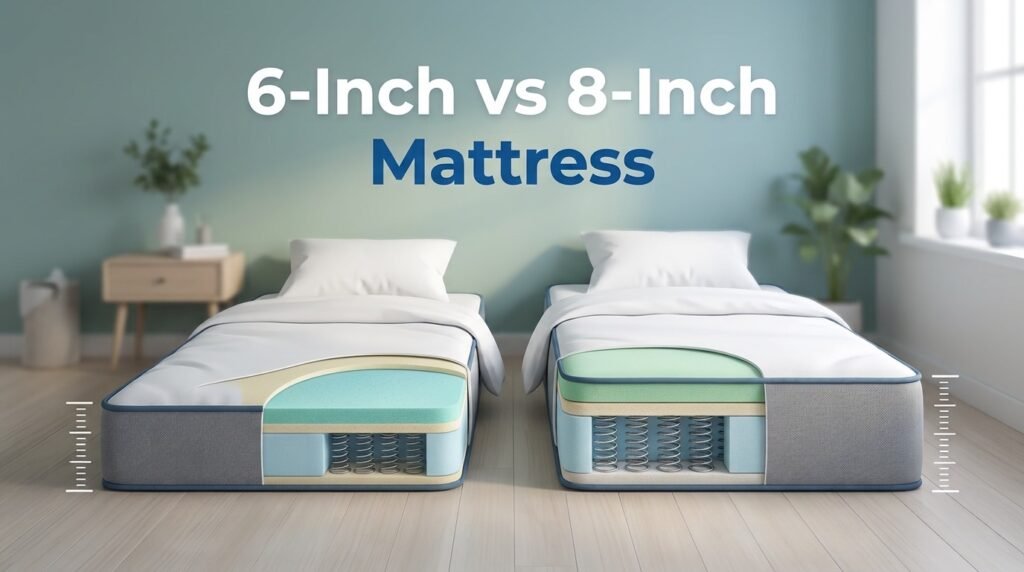
Are two extra inches really worth paying more for? It depends on who sleeps on the bed, how much they weigh, and where the bed will be used. Most adults sleeping every night do better on 8 inches. A 6-inch mattress works well for lighter sleepers, kids, and guest rooms.
Quick answer:
- Choose 6 inches for children, teens, lightweight adults, guest rooms, and tight budgets.
- Choose 8 inches for single daily adult use, side sleepers, couples, and anyone who wants more support.
- Choose neither if you weigh over 100 kg or need strong pressure relief. Look at 10 inches or more.
What Does Mattress Thickness Mean?
Thickness is the total height of the mattress, from bottom to top. It tells you how many layers the mattress can hold.
A 6 inch mattress usually has a base layer and a thin top layer. An 8-inch mattress has room for a thicker base and a more developed top layer. That extra depth changes how the bed supports your hips and shoulders.
Thickness alone doesn’t make a good mattress. A well-made 6-inch foam mattress can outperform a poorly made 8-inch one. Always check foam density and build quality, not just inches.
6-Inch Mattress: Who Is It For?
A 6-inch mattress is slim, light, and easy to move. It suits rooms where the mattress sees lighter or occasional use.
Good for:
- Kids’ and teens’ rooms
- Guest rooms and hostel beds
- Bunk beds and trundle beds, where height is limited
- Adults under roughly 60 kg who sleep on their back
- Anyone on a tight budget
Also Read: Which Mattress is Best For People With Back Problems
Watch out for:
- Heavier sleepers may sink through the top layer and feel the bed frame
- Side sleepers may feel pressure at the hips and shoulders
- It may wear out faster under daily adult use
8-Inch Mattress: Who Is It For?
An 8 inch mattress is the practical middle ground for most adults. The extra height gives the foam more room to absorb weight and spread it out.
Good for:
- Adults sleeping on it every night
- Side sleepers who need cushioning at the shoulders and hips
- Couples sharing a queen or king bed
- People with mild back stiffness who want steadier support
Watch out for:
- It costs more than a 6-inch version of the same type
- It is heavier to carry up stairs or move between homes
- Very heavy sleepers may still need something thicker
6-Inch vs 8-Inch Mattress: Side-by-Side Comparison
| Feature | 6-Inch | 8-Inch |
| Support for adults | Basic to moderate | Moderate to good |
| Pressure relief | Limited | Better |
| Weight | Lighter | Heavier |
| Typical use | Kids, guests, short-term | Daily adult use |
| Price | Lower | Higher |
| Best for | Under 60 kg | Roughly 60–90 kg |
These weight ranges are general guides, not strict rules. Foam quality changes the picture.
How to Choose Based on Your Sleep Style
Match the mattress to your body and sleeping position.
- Back sleepers: Either thickness can work if the foam is firm enough. Your spine stays fairly straight on a flatter surface.
- Side sleepers: Go with 8 inches. Your hips and shoulders press into the bed and need depth.
- Stomach sleepers: A firmer 6-inch or 8-inch mattress keeps your hips from sinking too low.
- Couples: Choose 8 inches. Two bodies put more load on the mattress.
- Back pain: Thickness helps, but firmness and support matter more. A medium-firm 8-inch mattress is a reasonable starting point. If pain continues, see a doctor.
Things to Consider Before Buying in Pakistan
Local conditions affect which thickness works better.
- Summer heat. Thicker foam can hold more warmth, especially during long power cuts when fans stop. If you sleep hot, look for breathable covers or open-cell foam, whichever thickness you pick.
- Bed frame and storage. Check your bed’s design first. A box bed or a frame with a shallow recess may not fit a thick mattress without it sitting too high.
- Standard sizes. Common sizes include single, queen, and king, but dimensions can vary between makers. Measure your frame before ordering.
- Moving and rentals. If you move often or live in a rented flat, a lighter 6-inch mattress is easier to carry up narrow stairs.
- Kids who grow fast. A 6-inch mattress is a sensible choice for children, since they will outgrow their bed in a few years anyway.
Quick Checks Before You Buy
- Weigh the main sleeper. Heavier bodies need thicker, denser foam.
- Ask about foam density. Higher density generally means better durability.
- Check the warranty. Look at what it covers, such as sagging beyond a set depth.
- Test it in person if possible. Lie down for at least five minutes in your normal sleeping position.
- Measure your frame. Confirm length, width, and any height limits.
- Look at the cover. A removable, washable cover makes cleaning easier in dusty weather.
Conclusion: Choose the Right Mattress Thickness!
If an adult will sleep on it every night, 8 inches is the safer pick. If the bed is for a child, a guest, or a lighter sleeper, 6 inches does the job and saves money. Check foam quality either way, since inches alone don’t decide how long a mattress lasts.
FAQs
Is an 8-inch mattress better than a 6-inch mattress?
For most adults, yes. The extra depth gives better support and pressure relief. A 6-inch mattress is still a good fit for kids, guest rooms, and lighter sleepers.
How thick should a mattress be for an adult?
Most adults do well with 8 to 10 inches. Lighter adults can manage with 6 to 8 inches, while heavier adults usually need 10 inches or more.
Is a 6-inch mattress good for back pain?
It can be, if the foam is firm and supportive. But for ongoing back pain, an 8-inch medium-firm mattress usually offers steadier support. Persistent pain should be checked by a doctor.
Can couples use a 6-inch mattress?
They can, but it isn’t ideal for nightly use. Two people put more weight on the bed, and a thin mattress may sag sooner. An 8-inch or thicker mattress is the safer choice.
Does mattress thickness affect how long it lasts?
Partly. Thicker mattresses can hold up better under daily use, but foam density and build quality count more. A dense 6-inch mattress can outlast a low-quality 8-inch one.