
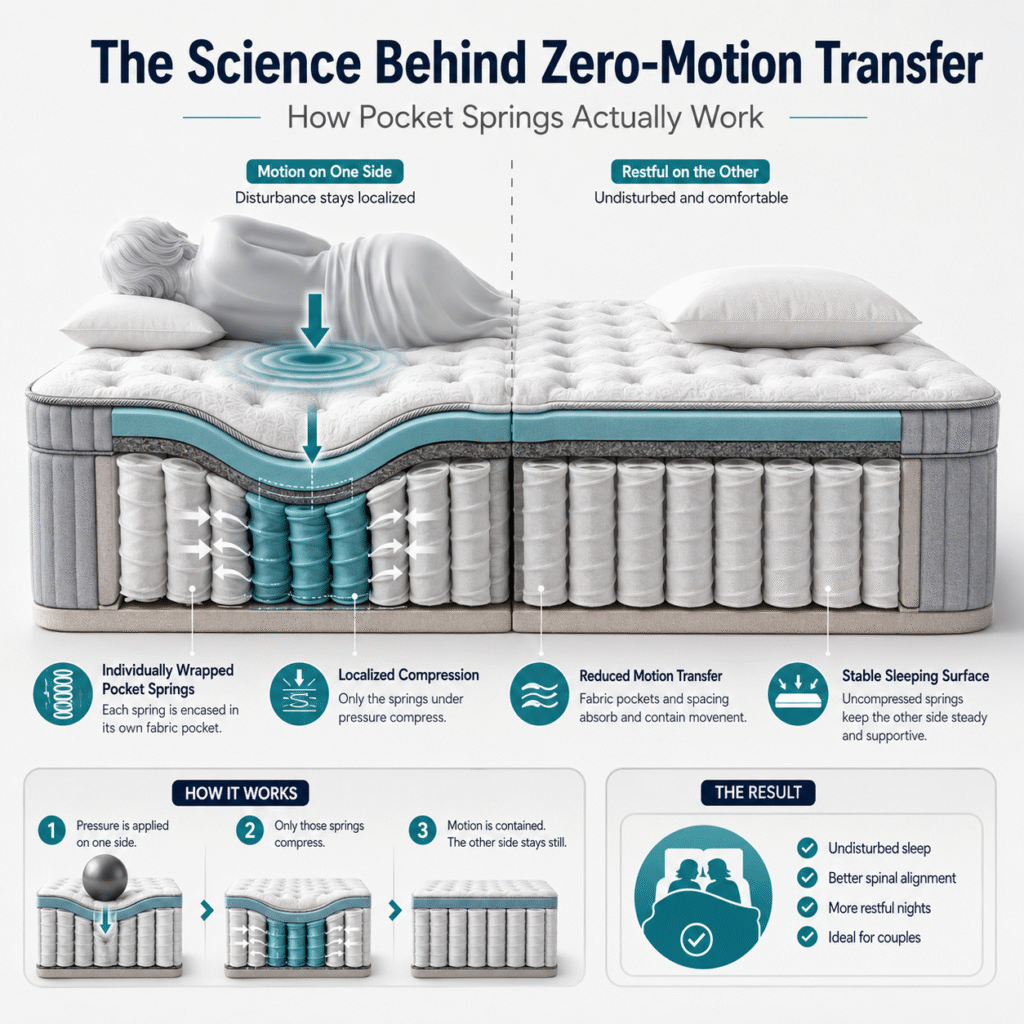
If you share a bed with a partner, a child, or even a restless pet, you know the feeling: every time they turn, wake up, or readjust, a miniature earthquake travels across the mattress, breaking your deep sleep. In the bedding industry, this disruption is known as motion transfer, and eliminating it is the primary goal of modern sleep engineering.
When exploring premium sleep systems in Pakistan, you will repeatedly encounter terms like “zero-motion transfer.” But what is the actual mechanical science behind this phrase? How can a mattress completely absorb kinetic energy on one side while remaining perfectly still on the other?
To understand how high-end options like Dolce Vita – the king of mattresses and other premium alternatives achieve this, we need to look beneath the fabric and examine the physics of pocket spring technology.
Read More: What is the Best Cooling Mattress in Pakistan?
The Mechanical Pitfall of Traditional Mattresses
To understand why pocket springs are so effective at isolating movement, it helps to look first at the classic open-coil systems that populated households for decades.
Traditional innerspring mattresses utilize a Bonnell coil system, where dozens of hourglass-shaped steel springs are laced together using a continuous network of helical wire. Mechanically, this creates a completely interconnected grid.
When weight is applied to a single spring, that spring pulls down every single coil attached to it. The entire surface functions like a giant trampoline or hammock. If one person rolls over, the kinetic energy moves freely through the continuous wire network, causing the entire bed to dip and bounce.
The Physics of the Pocket Spring: Defying the Ripple Effect
A pocket spring system entirely discards the interconnected mesh layout. Instead of a single network of wire, the architecture relies on hundreds, sometimes thousands, of separate, independent springs.
1. Individual Fabric Encasement
Each cylindrical steel coil is compressed and sealed inside its own durable, breathable fabric pocket. These fabric pockets are then glued together at their midpoints, rather than the steel coils being wired together.
2. Independent Axial Compression
Because the steel springs do not touch, they possess zero mechanical continuity. If you apply pressure to a single pocket spring, it compresses along its vertical axis completely on its own. The adjacent springs remain entirely uncompressed because no physical force is pulling them down.
3. Kinetic Energy Absorption
When a person turns or shifts weight, the kinetic energy is pushed downward directly into the independent vertical coils beneath them. The fabric casing acts as a dampener, absorbing the lateral energy before it can travel horizontally across the mattress surface. The result is true motion isolation.
Benchmarking Local Market Standards: The 1,000-Coil Threshold
When analyzing the luxury bedding tier in Pakistan, the efficacy of motion isolation depends heavily on the density and quality of the pocket spring matrix. Looking at standard market benchmarks helps illustrate how different engineering choices impact performance:
The High-Density Benchmark: Dreamer1000
A premier example of advanced motion isolation architecture is the Dreamer1000 series by Dolce Vita. By packing 1,000 individual pocket cells into a single master matrix, the mattress achieves a highly refined resolution of support. Because the points of contact are dense and tightly localized, the area of compression is incredibly small. A partner can literally get out of bed without creating a microscopic shift on the opposing side.
Alternative Market Options
In the Pakistani premium segment, such as Englander with their spring, or hybrid models use principles to isolate motion. While traditional foam setups like classic foam reduce motion transfer through dead-weight foam density, they lack the active, breathable upward push that independent steel coils provide.
Multi-Layer Integration: Foam and Fabric Support
The pocket spring core is only responsible for absorbing the deep kinetic energy. To provide a luxurious feel, it must work in tandem with specialized top comfort layers. In premium lineups like Dolce Vita, the core is usually paired with technical foam layers tailored to distinct preferences:
- Visco-Elastic Memory Foam: Found in variations like the Dreamer1000 Memory, this layer works with the pocket springs by slowing down body transitions and instantly contouring to heat and weight.
- Targeted Orthopedic Layers: Firmer technical foams used in the Dreamer1000 Support distribute weight evenly across specific zones, neutralizing pressure points in the lumbar region while keeping the lower spring base entirely quiet.
Comparison Matrix: Motion & Energy Dynamics
| Mattress Architecture | Under-the-Hood Engineering | Motion Isolation Rating | Heat Retention Properties |
| Traditional Open-Coil | Interconnected Bonnell wire grid | Poor (High bounce transfer) | Low (Excellent airflow) |
| Standard Solid Foam | Dense, continuous foam blocks | Good (Absorbs shock) | High (Traps body heat) |
| Premium Pocket Spring (e.g., Dreamer1000 by Dolce Vita ) | 1,000 Independent encased cells | Excellent (Zero Motion) | Low (Highly breathable matrix) |
Conclusion
Zero-motion transfer isn’t an invisible marketing trick, it is a straightforward result of deliberate mechanical engineering. By isolating steel coils within independent fabric cells, modern luxury mattresses eliminate the structural pathways that allow motion to travel.
If you are a light sleeper or share your bed, opting for a high-density, certified system like the Dolce Vita – the king of mattresses series ensures that kinetic disruptions become a thing of the past. It turns your bed into two separate, undisturbed sleep sanctuaries engineered into a single piece of furniture.
Frequently Asked Questions (FAQs)
Q1: Does a higher pocket spring count mean better motion isolation?
Yes. A higher coil count, such as the 1,000 individual springs found in the Dolce Vita Dreamer1000 mattress, means each individual spring cell is smaller and more localized. This limits the radius of compression to a much smaller zone, ensuring that movement is trapped exactly where it occurs without expanding outward.
Q2: Do pocket spring mattresses make noise over time like old spring beds?
No. Traditional spring mattresses creak because the interconnected steel coils constantly rub against one another and the wire frame. Because every single coil in a premium pocket spring mattress is fully encased in a thick, durable fabric pocket, there is zero metal-on-metal contact, resulting in completely silent performance.
Q3: How do pocket spring mattresses compare to memory foam for motion isolation?
Both excel at reducing motion transfer, but they do it differently. Solid memory foam absorbs motion by deadening the impact, which can sometimes create a “sinking” or “stuck” feeling while trapping body heat. Pocket springs isolate movement dynamically, providing an active upward push that keeps you on top of the mattress while maintaining clear, cool airflow through the open coil chambers.